
What Does Reverse Charge Mean?
The reverse-charge procedure is referred to as the reversal of tax liability. It is a special regulation within VAT law. The entrepreneur providing the service does not pay the VAT; instead, the recipient of the service is responsible for remitting the VAT.
Activating Reverse Charge in edoobox
Reverse Charge is not automatically active; it must be individually enabled by you in edoobox for the desired countries. Outside the EU, the laws of the respective country must be checked to determine if a reverse charge mechanism exists. To activate Reverse Charge, you must log in to edoobox V2. If V2 is not yet activated for your account, please send an email to support@edoobox.com with a brief request to activate V2 in your account.
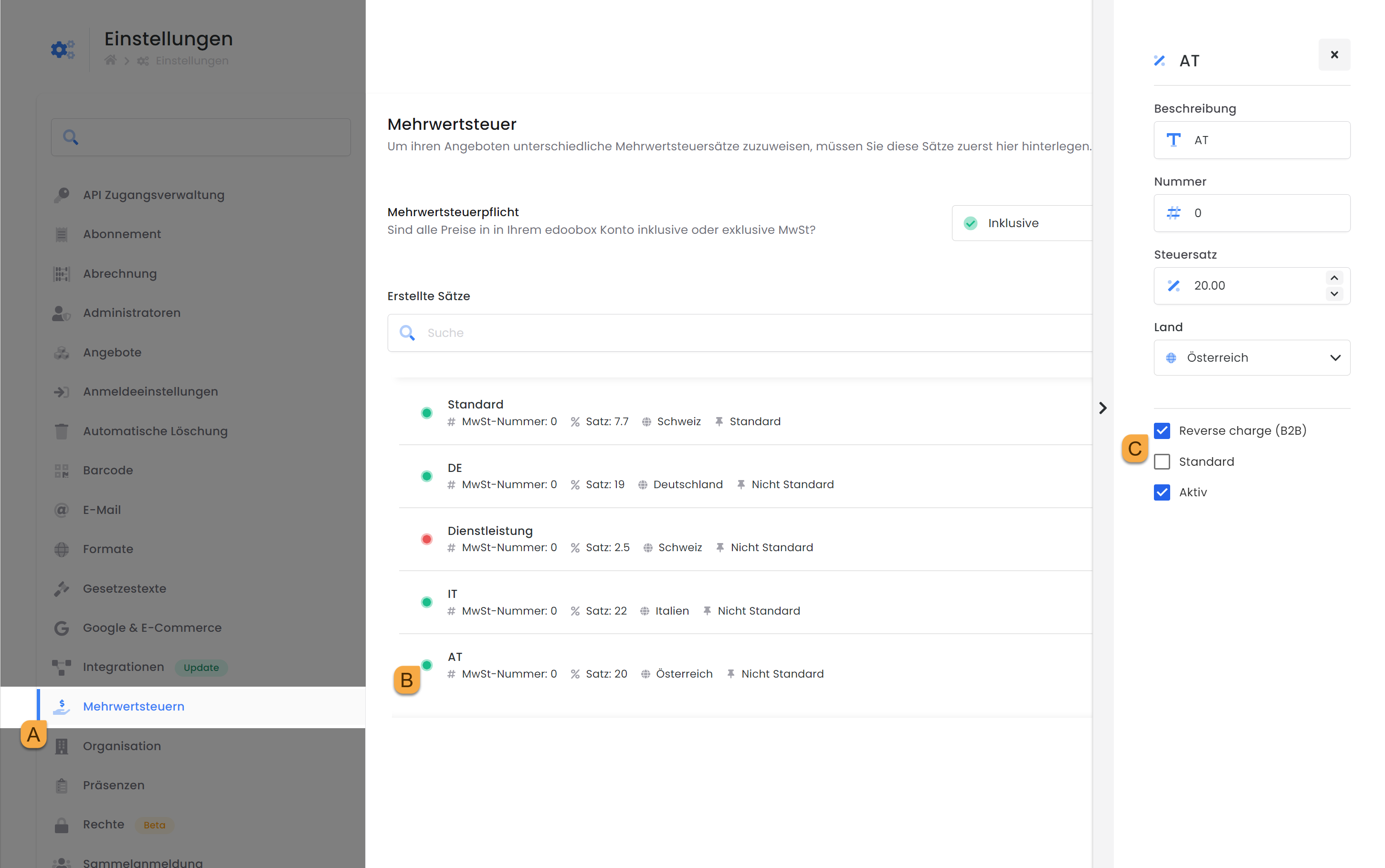
To enable reverse charge in V2, go to the "VAT" tab in the settings A. Click on the desired VAT rate B for which you want to enable reverse charge, and check the box next to "Reverse charge (B2B)" C.
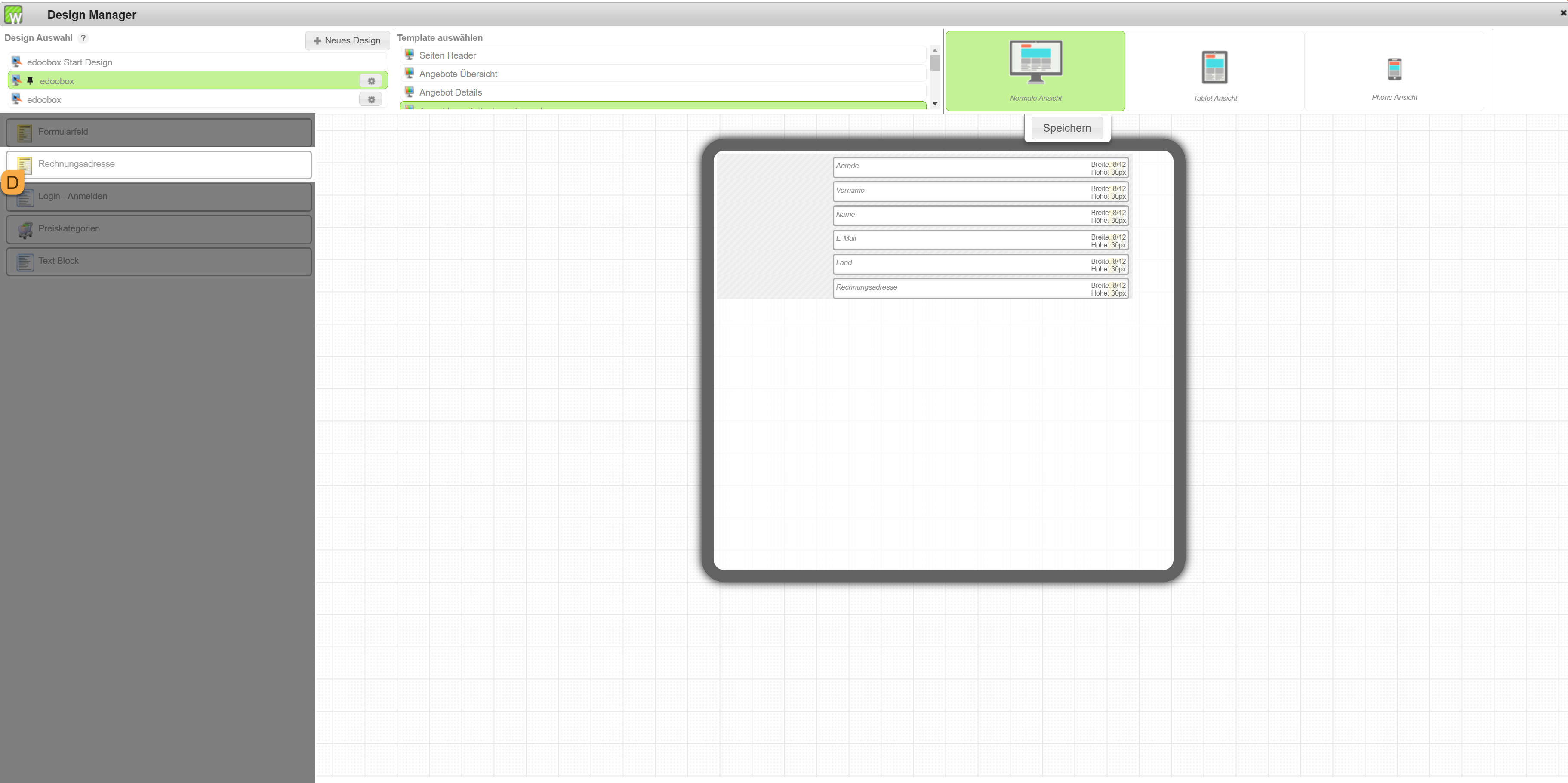
Once Reverse Charge has been activated for the desired VAT rate, the 'Billing Address' widget D must also be added to the participant form in the Design Manager. This widget is required because it prompts for the VAT number.
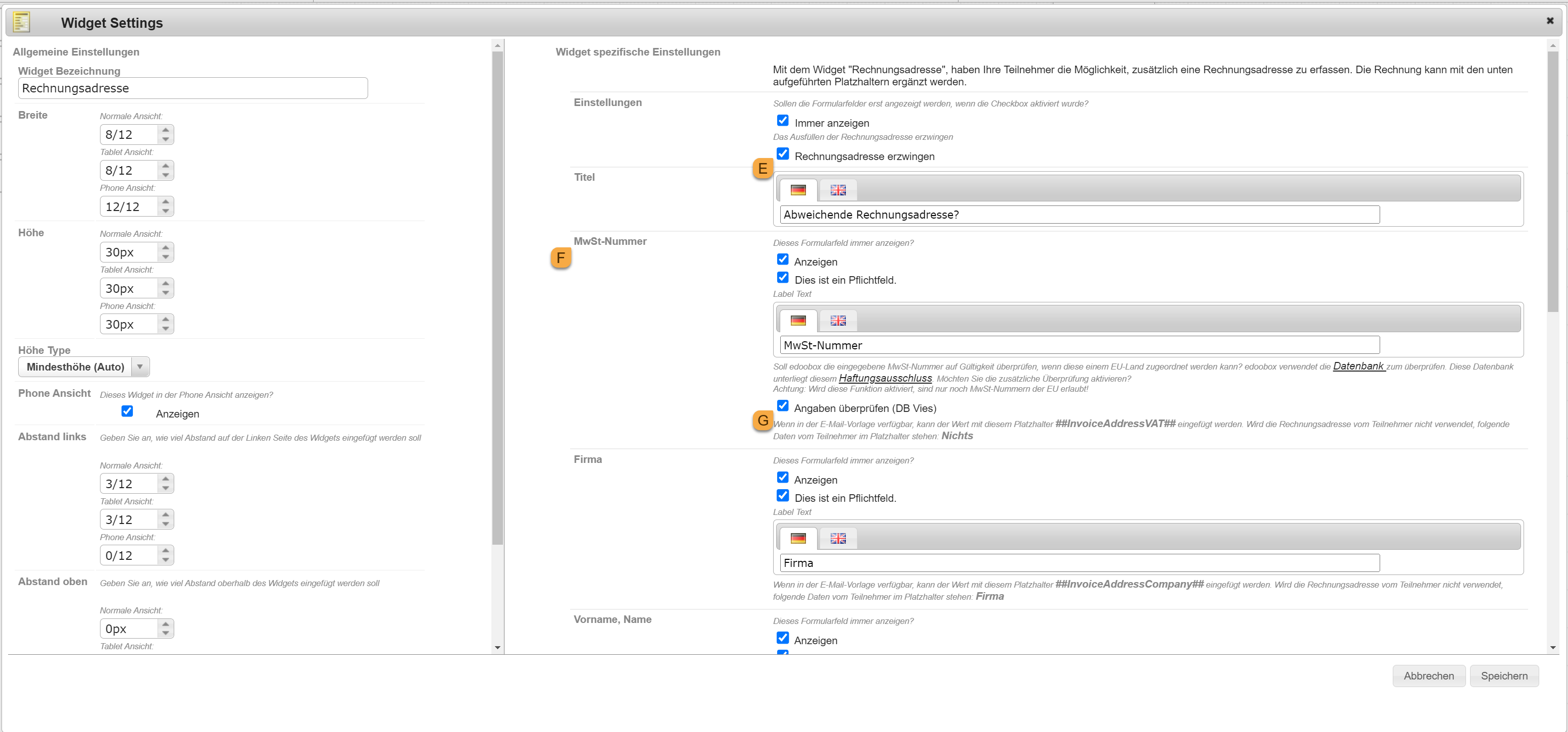
Once the billing widget is in the subscriber form, double-click the data field to open the settings. There, you will now see the option “Require billing address” E. If this option is selected, the data field becomes a required field; a booking cannot be completed without filling out the required fields. For the individual data fields in the billing address, you can then decide on a case-by-case basis whether they should be displayed and, if so, whether they should be required fields or not.
Would you like the VAT number entered by the person making the entry in the "VAT Number" field ( F) to be checked for validity (EU VAT numbers only)? Check the box next to "Check data (DB Vies)" ( G ).
Info: VAT Number
The B2B mode is activated even if the VAT number is not a mandatory field; the decisive factor here is either the VIES validation or if at least 5 characters are present.
Once Reverse Charge has been activated in the desired countries and the billing address added to the participant form, you have completed the setup for Reverse Charge (B2B).
If Reverse Charge (B2B) is active for a VAT rate and the VAT number provided in the billing address appears correct or has been validated, the booking will automatically be marked as a B2B booking and calculated accordingly.
The following points should be noted:
-
If your prices are inclusive of VAT, the VAT amount will be deducted; if prices are exclusive, the VAT amount will not be added.
-
For a group registration, edoobox refers to the main person of the booking. If it is merely a contact person without course participation, edoobox still refers to the contact person, as the billing address is requested from them.
-
Reverse Charge can be activated with GeoDynamic VAT or independently of it.
Activate/Deactivate Reverse Charge in an Existing Booking
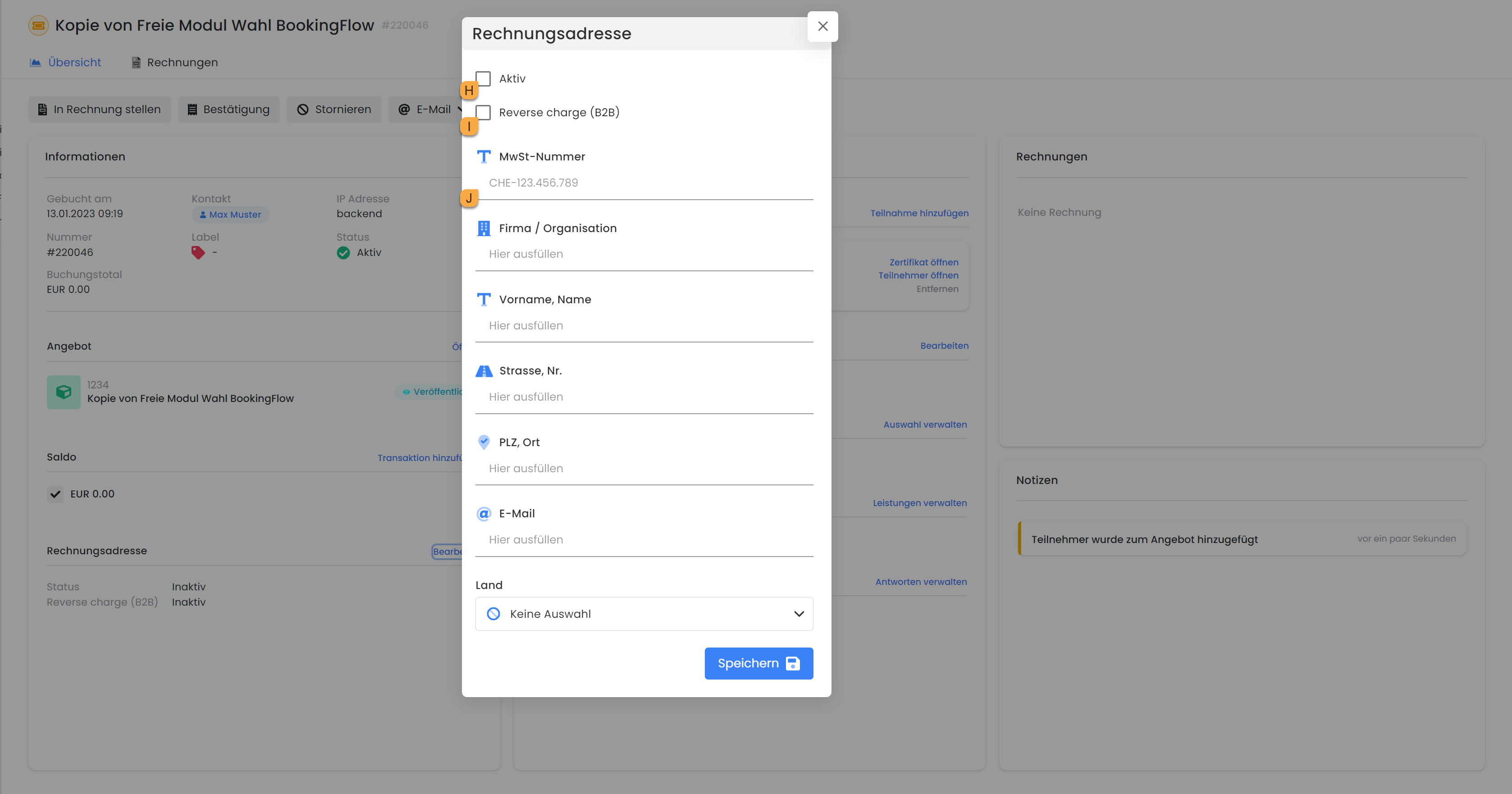
You can enable or disable reverse charge for an existing booking retroactively in the backend. In a booking, navigate to the billing address and click "Edit." If you want to add the reverse charge option to a booking after the fact, you must ensure that the billing address is enabled ( H), check the box next to “Reverse charge (B2B)” ( I), and add a valid VAT number (J). If you want to disable reverse charge, simply uncheck the box.
Please Note: Activating/Deactivating Reverse Charge
For both actions, it is imperative to update the invoice after the process to ensure it adjusts accordingly.
Tip: Supplement Invoice PDF with Additional Text
In the invoice, using IF-Conditions and the placeholder InvoiceIsReverseCharge additional text can be displayed if Reverse Charge is present in the invoice. Since the placeholder must be supplemented with true or false it is therefore only suitable in conjunction with an IF query.
Example with ELSE:
{IF?InvoiceIsReverseCharge = true}Invoice with Reverse Charge{ELSE}Invoice without Reverse Charge{ENDIF}
Example without ELSE:
{IF?InvoiceIsReverseCharge = true}Invoice with Reverse Charge{ENDIF}
Related Guides
Keywords for this guide
Reverse Charge | B2B | If-Conditions | VAT | Value Added Tax | GeoDynamic | DB Vies